1. Regional Microclimate Dynamics & Severe Storm Exposure in Tulsa, OK
Situated along the Arkansas River basin in northeastern Oklahoma, Tulsa's geographic and topographic layout exposes commercial and residential roof envelopes to violent seasonal climatological volatility. Elevated between 600 and 1,000 feet above sea level amidst the Osage and Boston mountain foothills, the Green Country region serves as a major atmospheric collision zone where moist maritime tropical air masses surging northward from the Gulf of Mexico collide violently with dry, dense continental polar fronts descending from the Canadian prairie. This persistent synoptic tension creates frequent convective instability, spawning severe supercells that produce hail Alley downbursts, localized microbursts with straight-line winds exceeding 75 to 85 mph, and sudden atmospheric pressure differentials across Tulsa, Wagoner, and Creek counties.
In Tulsa, local terrain contours — ranging from river valley microclimates to elevated residential ridges — create wind-funnel channels that accelerate wind velocities across roof planes. As high-velocity turbulent air passes over roof eaves, ridges, and valleys, it generates powerful aerodynamic uplift pressures according to Bernoulli's principle. When this negative suction force exceeds the manufacturer bonding rating of asphalt shingle sealant strips or fastener pull-through limits of metal standing seams, protective building coverings dislodge, exposing bare synthetic underlayment and structural plywood or OSB subdecking to driving rains. Furthermore, Green Country experiences over 50 freeze-thaw thermal cycles each winter, where moisture trapped within minute fissures freezes, expands by approximately 9 percent in volume, and mechanically widens hairline splits in shingles, mortar crowns, and valley pans.
Key Technical Engineering Protocols for Tulsa Storm Response
- Microburst Wind Uplift Defense: Installation of ASTM D7158 Class H wind-resistant shingles secured with a dedicated 6-nail nailing pattern and hand-sealed starter courses to withstand 130 mph design wind gusts across Green Country.
- Golf-Ball Hail Bruise Assessment: Calibrated 10x10 forensic test squares evaluating tactile mat fractures, granule dislodgement, and soft-metal collateral dents on furnace caps and AC condenser fins.
- Ridge-to-Eave Dual Waterproofing: Application of high-temperature self-adhering SBS ice-and-water shield along valleys, eaves, and sidewalls extending past interior building envelope plates.
- Rapid Hydrostatic Containment: Deployment of heavy-duty 10-mil poly tarps anchored with exterior 2x4 timber battens and neoprene gasketed screws within 60 to 90 minutes of emergency dispatch.
2. Non-Destructive Moisture Diagnostics & FLIR Thermal Tracing in Tulsa
Accurately diagnosing the point of origin for a roof breach in Tulsa requires advanced scientific instrumentation rather than destructive guesswork. Because roof decking slopes vary and structural framing directs water along horizontal pathways, an active ceiling stain in a central living room or kitchen may originate from an unsealed pipe boot collar, an attic fan flange, or a displaced valley pan forty feet away upslope.
Dispatched independent roofing contractors employ calibrated non-destructive testing (NDT) instruments. During post-sunset thermal transition hours, field technicians scan the roof envelope and interior ceiling planes using FLIR radiometric thermal imaging. Wet building insulation and saturated plywood subdecking retain solar thermal energy far longer than dry building materials; this thermal capacitance variance shows up distinctly on infrared camera monitors as clear temperature anomalies. Technicians verify these thermal patterns using pinless electronic impedance moisture meters, quantifying moisture content percentages within structural decking without puncturing sound roofing membranes.
3. Step-by-Step Substrate Restoration Methodology in Tulsa County
Following the completion of forensic inspections and initial emergency dry-in stabilization, dispatched independent roofing specialists execute permanent structural restoration following exacting building science specifications:
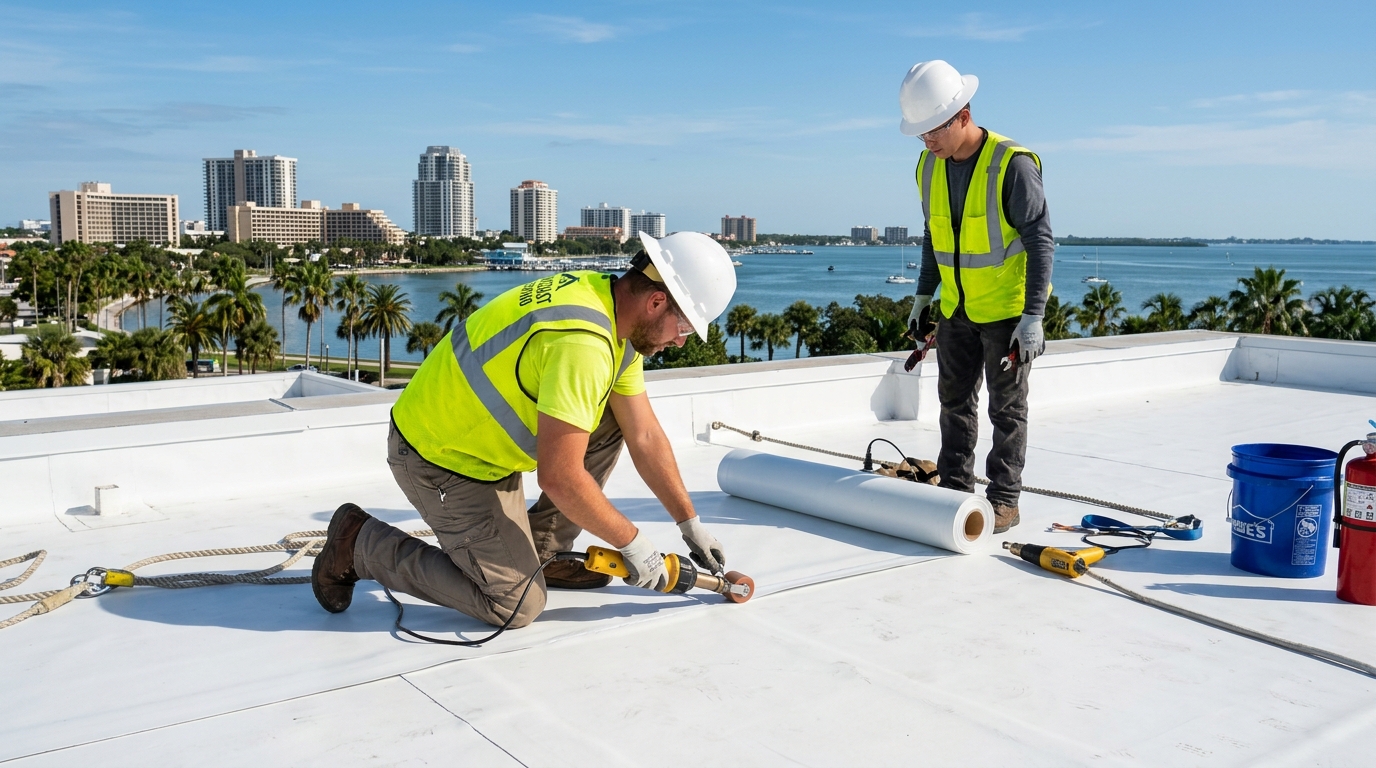
- Rigorous Site Safety & OSHA Anchorage Rigging: Technicians install temporary roof safety anchors compliant with OSHA 1926.502 regulations, securing full-body harnesses, shock-absorbing lanyards, and ladder stabilizer brackets before accessing steep-pitch Tulsa roof planes.
- Surgical Deconstruction of Compromised Layers: Damaged shingles, punctured membranes, or corroded flashings are carefully unsealed and removed starting two courses above the water intrusion boundary, removing fasteners cleanly without tearing adjacent sound materials.
- Subdecking Evaluation & CDX Plywood Replacement: Saturated or delaminated OSB or plywood sheathing is cut out along structural rafter centerlines and replaced with exterior-grade CDX panels fastened with hot-dipped ring-shank framing nails spaced at 6-inch perimeter intervals.
- Dual-Barrier Self-Adhering Waterproofing: Application of high-temperature self-adhering SBS modified bitumen ice-and-water barrier directly to the cleaned structural deck along all eaves, valleys, and sidewalls, followed by breathable spunbonded synthetic underlayment fastened with plastic-cap staples.
- Precision Material Installation & Sealant Application: Interlocking replacement Class 4 impact shingles or standing seam panels matched to existing profiles, integrated with 26-gauge galvanized steel flashings and hand-sealed with high-solids polyurethane elastomeric sealant along all vertical junctions.
4. Oklahoma Construction Industries Board (CIB) & Energy Code Compliance
All roofing restoration and emergency repairs executed in Tulsa, Broken Arrow, Jenks, and Owasso must comply strictly with the Oklahoma Roofing Contractor Registration Act and localized municipal adoptions of the International Residential Code (IRC) and International Building Code (IBC). In Oklahoma, professional roofing contractors are legally required to hold an active, valid commercial or residential roofing registration issued by the Oklahoma Construction Industries Board (CIB), maintain at least ,000,000 in commercial general liability insurance, and carry statutory workers' compensation insurance.
Dispatched independent roofing contractors secure all mandatory municipal permits, coordinate required mid-point roof inspections with local building officials, and ensure compliance with current building energy conservation standards (minimum R-38 to R-49 attic thermal insulation and balanced passive attic ventilation calculated at a 1:150 or 1:300 net free area ratio). Ensuring complete regulatory compliance protects homeowner insurance claims, preserves manufacturer warranties, and prevents municipal stop-work orders.
5. Preventative Property Maintenance & Severe Storm Preparedness in Tulsa
Given Tulsa's high frequency of severe convective storms and microbursts, proactive roof maintenance is vital for preserving building value and preventing unexpected catastrophic leaks. Property owners should schedule professional inspections twice annually — each spring before the primary severe weather season begins and each autumn before winter freezes.
Essential preventative maintenance protocols include clearing accumulated leaves and organic debris from valley troughs and gutter downspouts, trimming mature oak branches to maintain at least an 8-to-10 foot clearance envelope from roof perimeters, and inspecting rubber plumbing pipe boots and chimney mortar joints for hairline cracks. Following severe hail or wind storms across Green Country, property owners should check ground-level soft metals such as window air conditioning fins, metal mailboxes, and downspouts, which provide reliable collateral indicators that professional rooftop forensic evaluation is warranted.
Active Storm Damage or Roof Breach in Tulsa?
Zero web forms, zero automated delays. Speak directly with an emergency intake coordinator to route vetted, licensed Oklahoma roofing contractors to your property now: